
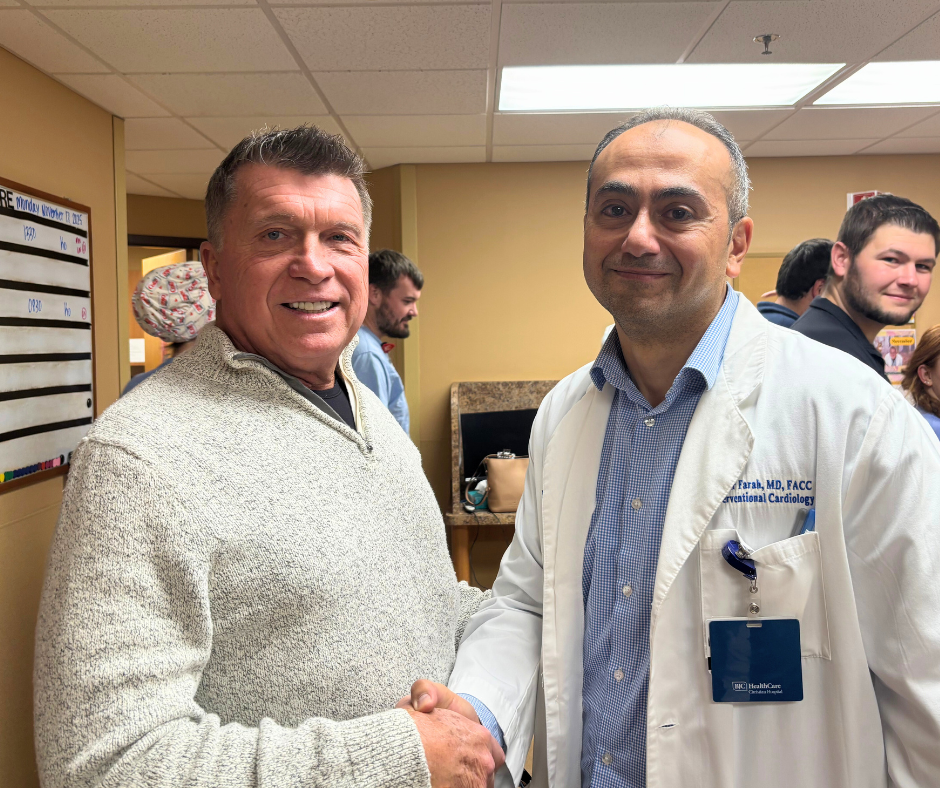
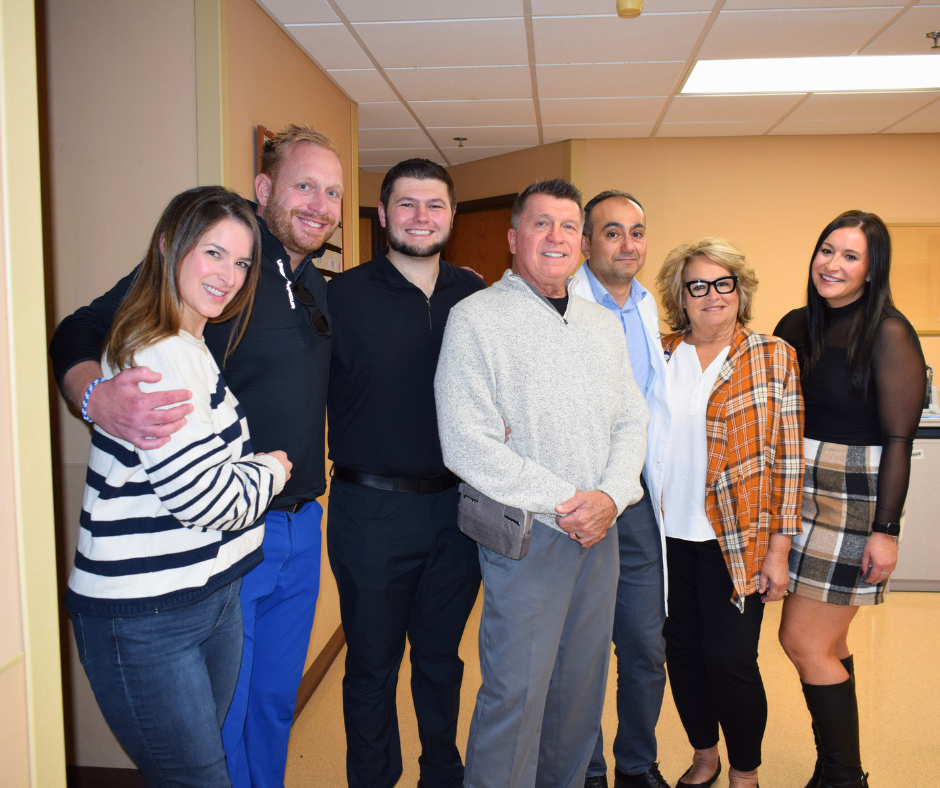
Brian Sweet, Dr. Farah, Cynthia Sweet and Jordan Sweet.
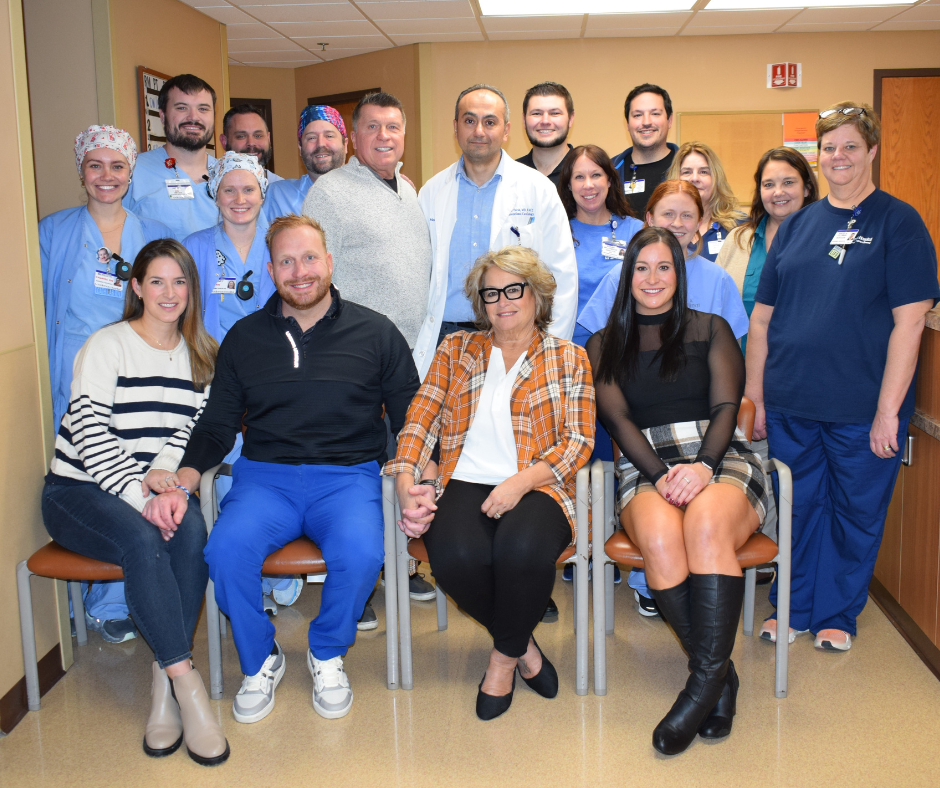
Anderson Cardiac Cath Team Staff with ER Staff, Dr. Farah, Josh Estes
and the Sweet Family.
Before sharing her father Brian’s incredible story of survival, it’s worth knowing that Jordan’s connection to Anderson Hospital runs deep. She spent a year working in our ER during the early days of COVID, and her grandmother — Brian’s mom — was a beloved switchboard operator here for 30 years.
Now, Jordan is sharing the story that forever changed their family: the day her dad suffered a massive heart attack and the remarkable fight for life that followed.
Brian Sweet's Story of Survival
By Jordan Sweet, APRN, FNP-C
On Wednesday, September 3, Brian Sweet suffered a massive heart attack after returning home from the gym. Luckily, his wife, Cindy, was home and able to provide life-saving CPR while calling 911. First responders from the Collinsville police department and fire department arrived and quickly took appropriate action to save Brian’s life, providing CPR, airway support, medications, and defibrillation.
Brian was rushed to Anderson Hospital in very critical condition, where he was emergently treated in the ER for cardiac arrest. He was stabilized and underwent a procedure in the cardiac cath lab to check for blockages in his heart, called a cardiac catheterization. His heart had three major arteries blocked that could not be fixed, despite multiple attempts by Dr. Farah. However, the doctor was able to place a life-saving pump in his heart called an Impella. Brian remained in very critical condition, requiring multiple defibrillations and CPR due to an abnormal heart rhythm throughout the procedure.
He was then air-lifted to Barnes-Jewish Hospital cardiac ICU. He underwent another cardiac catheterization, where Dr. McNeely was successful in clearing 2 of the 3 major blockages in Brian's heart. Brian's condition continued to improve greatly, but he was still in very critical condition. The Impella was helping his heart pump blood so that it was not being overworked while he recovered. The following two days, he had been awake off and on, opening his eyes, squeezing loved ones’ hands, and even trying to talk, despite having a breathing tube in. He had shown strength and tenacity beyond measure.
Friday, September 5, Brian underwent surgery to put in a new Impella 5-5 heart pump to replace the original one placed on September 3rd by Dr. Farah. The procedure went well, and Brian was recovering. However, that night, things took a turn for the worse, and Brian suffered another cardiac arrest, requiring CPR and defibrillation. The cardiothoracic surgeon, Dr. Masood, decided to place Brian on a supportive machine called ECMO to give his heart and body rest. That was the longest night of the Sweet family’s life. 3 am Saturday morning, and now in an upgraded cardiothoracic ICU, the family finally got to see Brian. He looked like a shadow of the man they knew. At this time, the family had prepared itself for the worst news.
Saturday, Brian remained intubated and sedated, requiring blood transfusions overnight and still having undesirable heart rhythms. During the day, the nurses were able to wean his sedation and check his neurological status…Brian was completely neurologically intact, despite being told he may have suffered brain damage from his cardiac arrest. This was fantastic news for the family, and they remained hopeful.
The following day, Brian remained sedated, and the family met with the cardiothoracic surgeon. On Sunday morning, the entire Sweet family gathered in a conference room to be told that Brian only had a 5-10% chance of a full recovery, he was not a candidate for a heart transplant, and the only option was, he would require a device called an LVAD to support the left side of his heart for the remainder of his life. That news was devastating, but the family was hopeful for a chance for Brian to survive this traumatic event and continue to live a promising life with his family.
Monday, the cardiothoracic surgeon decided to remove the breathing tube that was supporting Brian because he had been making such great advancement in the previous 24 hours...finally, Brian was awake, and he could talk to his family! The following day, Tuesday, Brian was taken to the OR and the supportive ECMO was removed. The doctors repeated a heart function test on Brian, and his heart had returned to almost normal function. The doctors were astounded and at a loss for words!
Brian continued to recover incredibly well the next few days with no setbacks. On Friday, September 12, the Impella heart pump that was supporting Brian’s heart was removed. He was monitored closely in the ICU for the following 2 days. He was able to downgrade to a cardiac step-down floor, exiting the ICU with Head East's “Never Been Any Reason” playing as the nurses transferred him out in a wheelchair to his new room.
Brian spent the following week on the cardiac step-down floor, being closely monitored for any unusual heart rhythms or events. He took walks around the floor, was able to shower, and had many visitors. Each doctor and nurse who knew Brian was just as surprised as the next to know his incredible story of resilience and recovery.
Brian spent a total of 15 days at Barnes-Jewish Hospital.
Thursday, September 18, his daughter Jordan drove him home from the hospital with no assistive devices and a nearly normal functioning heart.
Brian has been required to wear a Lifevest for 90 days that monitors his heart for any abnormal rhythms and will deliver a shock if needed. His follow-up appointment with his cardiologist was reassuring. At an outpatient cardiac catheterization on October 3rd, he received two more stents in his heart to prevent any future cardiac events.
He has been walking daily, attending cardiac rehab, and has returned to his normal life, spending time with his family, friends, and visiting his lake house in the Ozarks.
On October 14th, Brian was able to reconnect with the first responders who saved his life on September 3rd, awarding them with Lifesaver Awards, shaking their hands, and expressing his gratitude for the ultimate gift of life.
On November 17, Brian and his family reconnected with Anderson Hospital ER staff and Cardiac Cath Team with special thanks and admiration for interventional cardiologist, Dr. Farah. Brian remains forever grateful for the first responders, doctors, nurses, family, friends, and everyone involved in his care and recovery.